
The Push/Pull/Legs split isn’t hype — it’s just math. It hits every major muscle group twice per week, respects recovery windows, and gives you clear organization instead of guessing what to train each day.
Whether you’re stepping into a gym for the first time or squeezing gains out of years of training, PPL scales with you. This guide walks through the full framework: the weekly schedule for 3, 4, or 6 training days, exercise selections for each day, rep ranges, progression rules, and the beginner-to-advanced adjustments.
It’s a core piece of STSH’s complete muscle-building framework — the “how you train” pillar.
What PPL Is And Why It Works
Push/Pull/Legs groups exercises by the mechanical action muscles perform:
- Push day: chest, shoulders, triceps (all press away from the body)
- Pull day: back, biceps, rear delts (all pull toward the body)
- Leg day: quads, hamstrings, glutes, calves (all lower-body)
Every muscle group gets its own dedicated day with related muscles that share workload. Your chest and triceps both get hit hard on push day — that overlap is a feature, not a bug. It means you’re never doing chest one day and finding out on tricep day that your triceps are already smoked.
The efficiency advantage over bro splits (chest Monday, back Tuesday, shoulders Wednesday, etc.) is meaningful: PPL lets you hit every muscle twice per week, and research consistently shows twice-a-week frequency beats once-a-week for hypertrophy at the same total volume. If you’re only training a muscle group once every 7 days, you’re leaving growth on the table.
The efficiency advantage over full-body training is also real: PPL lets you use more volume per session on each muscle group without turning workouts into 2-hour marathons.
The Weekly Schedule (3-Day, 4-Day, And 6-Day Options)
PPL adapts to whatever training frequency you can sustain. Pick the version that fits your life.
3-Day PPL (Beginner Or Busy Schedule)
| Mon | Tue | Wed | Thu | Fri | Sat | Sun |
|---|---|---|---|---|---|---|
| Push | Rest | Pull | Rest | Legs | Rest | Rest |
Every muscle group hit once per week. Simplest to run. Fine for beginners in months 1-3 or anyone with a legitimately limited schedule. Growth is slower than 6-day PPL but it’s still real growth.
4-Day PPL (Upper/Lower Hybrid)
| Mon | Tue | Wed | Thu | Fri | Sat | Sun |
|---|---|---|---|---|---|---|
| Push | Pull | Rest | Legs | Upper (light) | Rest | Rest |
Adds a modest upper-body session on day 5 to squeeze in a second frequency without demanding a 6-day commitment. Sweet spot for intermediate lifters with day-job constraints.
6-Day PPL (The Classic — Most Gains For Most People)
| Mon | Tue | Wed | Thu | Fri | Sat | Sun |
|---|---|---|---|---|---|---|
| Push | Pull | Legs | Push | Pull | Legs | Rest |
Every muscle group hit twice per week. This is the version most guys building serious muscle run. The first push day is heavy strength focus; the second push day is higher-volume hypertrophy focus. Same for pull and legs. The two rotations give you the recovery window your body needs.
The critical rule: you MUST take that rest day. Running 7 days straight destroys recovery within 2-3 weeks and stops your progress cold. The rest day isn’t optional.
Push Day Breakdown: Chest, Shoulders, Triceps

Your push day trains everything you press away from your body.
| Exercise | Sets × Reps | Rest | Notes |
|---|---|---|---|
| Barbell bench press | 4 × 6-8 | 2-3 min | Compound; open with your heaviest lift |
| Overhead press (barbell or dumbbell) | 4 × 6-8 | 2-3 min | Second compound; hits shoulders + triceps |
| Incline dumbbell press | 3 × 8-12 | 90 sec | Upper chest emphasis |
| Cable chest fly | 3 × 12-15 | 60 sec | Stretch under load |
| Lateral raises | 4 × 12-15 | 60 sec | Side delts — often the weak link |
| Tricep rope pushdown | 3 × 12-15 | 60 sec | Isolation for tricep growth |
| Overhead tricep extension | 3 × 10-12 | 60 sec | Long head of tricep |
Warm up with 2-3 progressively heavier sets on your opening lift. Working sets are only counted after warmups. Sets × rep numbers are working sets, not including warmup.
On your second push day of the week (6-day PPL), swap bench for close-grip bench, swap overhead press for landmine press, and drop one isolation each for a slightly different stimulus.
Pull Day Breakdown: Back, Biceps, Rear Delts

Your pull day trains everything you pull toward your body — the opposite pattern of push day.
| Exercise | Sets × Reps | Rest | Notes |
|---|---|---|---|
| Deadlift OR barbell row | 4 × 5-8 | 3 min | Alternate the two across the week |
| Pull-ups OR lat pulldown | 4 × 6-10 | 2 min | Vertical pulling |
| Chest-supported row | 3 × 8-12 | 90 sec | Removes lower back fatigue |
| Face pulls | 3 × 15-20 | 60 sec | Rear delts and shoulder health |
| Barbell curl | 3 × 8-12 | 90 sec | Compound bicep |
| Hammer curl | 3 × 10-12 | 60 sec | Brachialis + forearms |
| Cable curl | 3 × 12-15 | 60 sec | Finish with the pump |
The bicep peak specifically responds to certain rep ranges and grip variations — our long-head bicep workout guide breaks that down further if that’s your sticking point.
Rows in various angles (chest-supported, seated cable, T-bar) build back thickness. Pull-ups and pulldowns build back width. You need both.
Leg Day Breakdown: Quads, Hamstrings, Glutes, Calves

Leg day is where most guys quit and most gains happen.
| Exercise | Sets × Reps | Rest | Notes |
|---|---|---|---|
| Back squat | 4 × 5-8 | 3 min | The king of leg exercises |
| Romanian deadlift | 4 × 6-10 | 2-3 min | Hamstrings + glutes |
| Leg press | 3 × 10-15 | 2 min | Higher volume for quad growth |
| Bulgarian split squat | 3 × 10-12 each leg | 90 sec | Unilateral; kills imbalances |
| Leg curl (lying or seated) | 3 × 12-15 | 60 sec | Direct hamstring isolation |
| Standing calf raise | 4 × 12-15 | 60 sec | High reps for calves |
| Seated calf raise | 3 × 15-20 | 45 sec | Soleus target |
If your knees can’t tolerate heavy back squats, front squat or hack squat as alternatives. Never train through joint pain.
Leg day at hard intensity leaves you drained. Schedule it before your rest day when possible.
Sets, Reps, And Rest — How To Think About The Numbers
Working sets: The sets AFTER warmup that count toward volume. Aim for 10-20 working sets per muscle group per week across all your sessions combined.
Rep ranges:
- 5-8 reps: heavier weight, strength emphasis, compound movements
- 8-12 reps: the hypertrophy sweet spot for most exercises
- 12-15 reps: metabolic stress, isolation exercises, cables
- 15-20+ reps: endurance / high-fatigue lifts like calves and lateral raises
Vary rep ranges across the week. A pure high-rep or pure low-rep approach both leave gains on the table.
Rest times:
- 3+ minutes: heavy compounds (squat, deadlift, bench)
- 90 sec – 2 min: moderate compounds (rows, incline press)
- 45-60 sec: isolation (curls, tricep pushdowns, calves)
Cutting rest to hit “cardio and lifting” simultaneously actively hurts hypertrophy. Rest fully between working sets on compound lifts.
Progressive Overload — The Actual Growth Mechanism
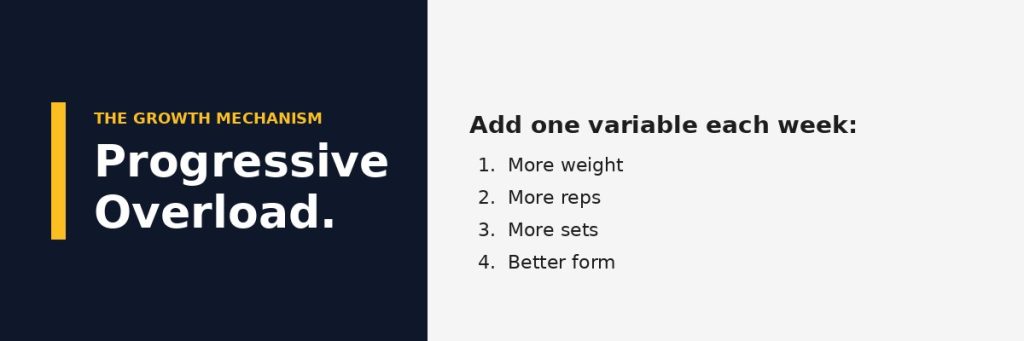
Muscles grow when you progressively demand more of them. Same weight, same reps, same rest = no reason for your body to build new tissue.
Add one of these each week:
- More weight (add 2.5-5 lbs to a lift when you hit the top of your rep range across all working sets)
- More reps (same weight, one more rep per set)
- More sets (add a working set to a muscle group you want to prioritize)
- Better form (tighter tempo, deeper range of motion, less momentum)
Track your lifts. A notebook or a phone note works fine. If you’re not tracking, you’re not progressing — you’re guessing.
Beginner Vs Intermediate Vs Advanced Variations
Beginners (0-12 Months Of Training)
- Run 3-day PPL for 3-6 months
- Focus on form and adding weight to compounds
- Stick with the exercise template — don’t program-hop
- Expect meaningful strength gains in the first 6 months (novice gains)
- Progress: add weight nearly every session
Intermediate (1-3 Years)
- Move to 4-day or 6-day PPL
- Add periodization: 4-week strength blocks alternating with 4-week hypertrophy blocks
- Track lifts in a real log
- Include unilateral work (Bulgarian split squats, dumbbell presses)
- Progress: add weight every 1-2 weeks
Advanced (3+ Years)
- 6-day PPL with the heavy/volume split
- Add specialization phases — 8 weeks emphasizing one weak muscle group with extra sets
- Include intensity techniques: drop sets, rest-pause, mechanical advantage supersets
- Progress: add weight every 3-4 weeks with careful periodization
Advanced lifters often benefit from studying how Hollywood physiques were built — Chris Hemsworth’s Thor training and Alan Ritchson’s Reacher transformation both used variations of Push/Pull/Legs structuring.
Common PPL Mistakes That Stall Progress
Ego lifting on compounds. Half-repping bench with 315 doesn’t build a chest. Reduce the weight, use full range of motion, and let the muscle actually do the work.
Skipping leg day. Every guy who’s tried this eventually deals with the consequences — imbalances, injury risk, and a lower body that doesn’t match the upper. Legs pull their weight in the split for a reason.
Adding random exercises to feel productive. More exercises ≠ more growth. Stick with the template of 5-7 exercises per session. Volume matters, exercise variety within a session doesn’t as much.
Cutting rest to save time. 60-second rest between heavy compound sets means your working sets aren’t actually at working intensity. Save the time by cutting an isolation exercise if needed, not by rushing rest.
Running the same program for 12+ months without progression. Same weight, same reps, same exercises = your body has adapted and stopped growing. Change one variable — weight, volume, frequency, or exercise selection — every 6-8 weeks.
Ignoring recovery outside the gym. PPL demands 7-9 hours of sleep and adequate calories. Under-recovering + high training volume = injury and burnout in 3-6 months.
Final Thoughts
Pick your version (3-day, 4-day, or 6-day) based on your available time. Print the exercise templates. Track your working sets. Add one variable of progression each week. Sleep 7-9 hours. Eat enough. Show up.
That’s the entire game.
For where training fits alongside nutrition, hormone support, and specific programs like the ones Hollywood uses to build screen physiques, STSH’s complete muscle-building framework covers the full picture.
The rack is waiting.
Frequently Asked Questions
How Long Until I See Results From PPL?
Strength gains show up in 2-3 weeks — your lifts start moving. Visible muscle changes take 8-12 weeks of consistent training with adequate nutrition. Dramatic transformations (10+ pounds of visible muscle) require 6-12 months. Anyone promising faster is selling something. Consistency across months beats intensity across weeks.
Can I Do Cardio On PPL?
Yes, but keep it lighter and don’t sabotage your leg day recovery. Two to three sessions per week of 20-30 minutes of steady-state cardio (or one HIIT session) fits without eating into gains. Do cardio on rest days or after lifting sessions, not before. If you’re bulking hard and struggling to gain weight, cut cardio to 1-2 sessions per week.
Is PPL Good For Cutting Or Only For Bulking?
PPL works during a cut as long as protein stays high (1g per pound bodyweight minimum) and calories are only in a modest deficit (300-500 below maintenance). During aggressive cuts, drop to 4-day PPL to reduce total volume — recovery is compromised in a deficit and you can’t push the same volume you would while bulking. You’ll maintain strength on lower volume; adding volume just accelerates fatigue.
References
- Schoenfeld BJ, Ogborn D, Krieger JW. (2016) – Effects of Resistance Training Frequency on Measures of Muscle Hypertrophy: A Systematic Review and Meta-Analysis. Sports Medicine. 46(11):1689-1697.
- Krzysztofik M, Wilk M, Wojdała G, Gołaś A. (2019) – Maximizing Muscle Hypertrophy: A Systematic Review of Advanced Resistance Training Techniques and Methods. Int J Environ Res Public Health. 16(24):4897.
- Grgic J, Schoenfeld BJ, Latella C. (2019) – Resistance training frequency and skeletal muscle hypertrophy: A review of available evidence. J Sci Med Sport. 22(3):361-370.
- Schoenfeld BJ, Grgic J, Van Every DW, Plotkin DL. (2021) – Loading Recommendations for Muscle Strength, Hypertrophy, and Local Endurance: A Re-Examination of the Repetition Continuum. Sports (Basel). 9(2):32.
- Ralston GW, Kilgore L, Wyatt FB, Baker JS. (2017) – The Effect of Weekly Set Volume on Strength Gain: A Meta-Analysis. Sports Medicine. 47(12):2585-2601.