
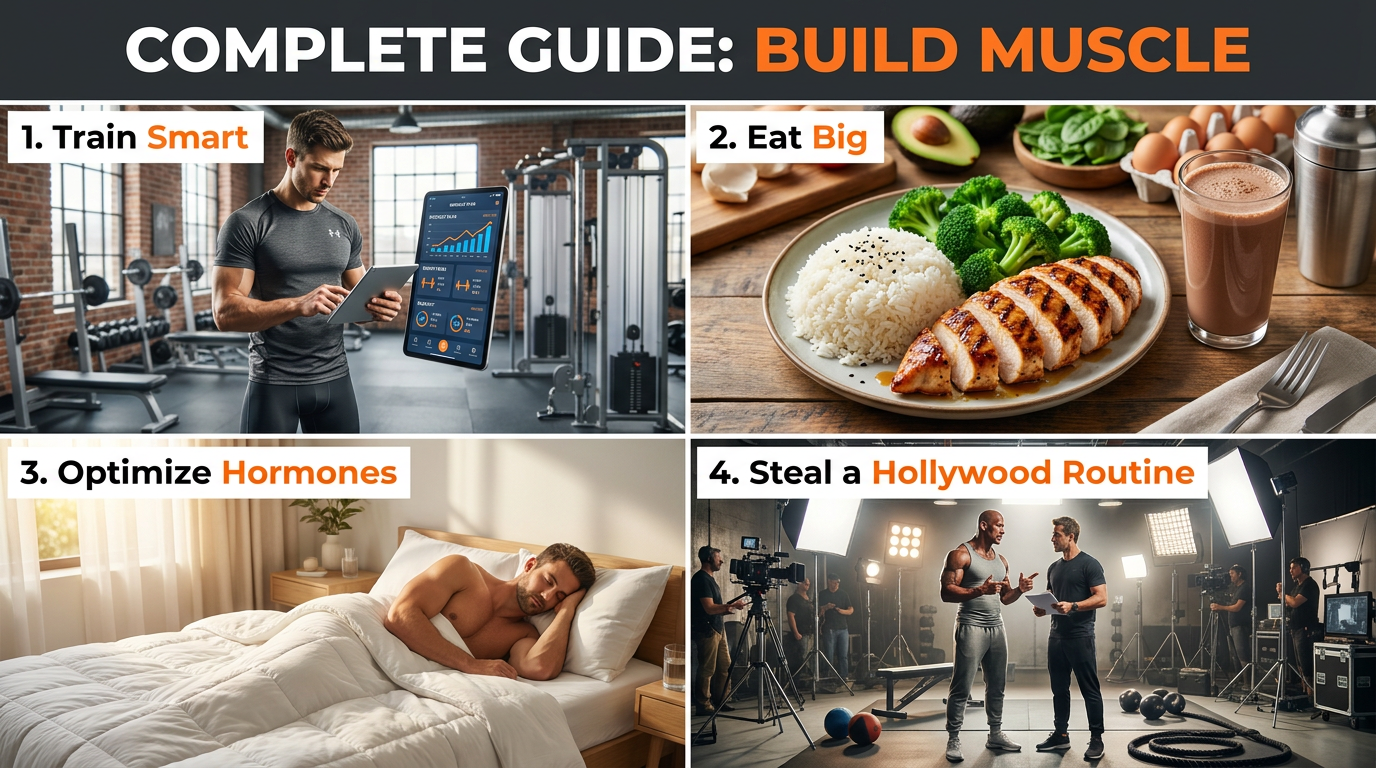
Building muscle isn’t complicated. It’s just hard to execute consistently.
The framework has been the same for fifty years: progressively overload your muscles under load, eat a modest calorie surplus with enough protein, keep your hormones in a state that lets recovery happen, and stay at it long enough for the numbers to compound. Everything else — the supplements, the exotic exercises, the 4 AM cold plunges — is downstream of those four pillars.
This guide breaks each pillar down: how to train, how to eat, how to optimize the hormonal environment that turns training and food into muscle, and how the Hollywood transformations you’ve seen on screen actually got built. Every section links to the deeper STSH guides where you’ll find the specifics. Read this all the way through and you’ll have the map. Then you just have to walk it.
Building muscle comes down to four pillars — progressive resistance training, a slight calorie surplus with enough protein, balanced hormones, and consistent recovery. The rest of this guide breaks down each pillar with research-backed protocols and links to STSH’s most-read training and supplement guides.
Skim time: 5 minutes. Full read: 18 minutes.
01. Train Smart

Muscle grows when you damage muscle fibers under load, then let your body rebuild them stronger. That’s the entire biological game. What separates guys who make consistent gains from guys who plateau isn’t program complexity — it’s whether they’re actually applying progressive overload week over week.
Progressive overload has four levers you can pull: more weight, more reps at the same weight, more sets, or better form. If none of those are moving upward across a 4-week window, you’re maintaining, not growing.
The other core requirement: hit each major muscle group twice per week. Research since the early 2010s consistently shows twice-a-week training frequency beats once-a-week at equal weekly volume. This is why bro splits (chest Monday, back Tuesday, etc.) underperform Push/Pull/Legs splits over 12-month timelines — the frequency structurally favors the split, not the individual working out.
Beginners: 3-day Push/Pull/Legs run for 3-6 months, then upgrade to 6-day PPL as you develop training capacity. Intermediates: 4-day or 6-day PPL with heavy/volume alternation across the week. Advanced: 6-day PPL with periodized specialization phases and occasional intensity techniques.
Rest matters more than most guys admit. Seven to nine hours of sleep, one full rest day per week minimum, and full inter-set rest on heavy compounds (3+ minutes) are non-negotiable. Under-recovering while pushing high volume produces flat gains and injury within six months.
02. Eat Big
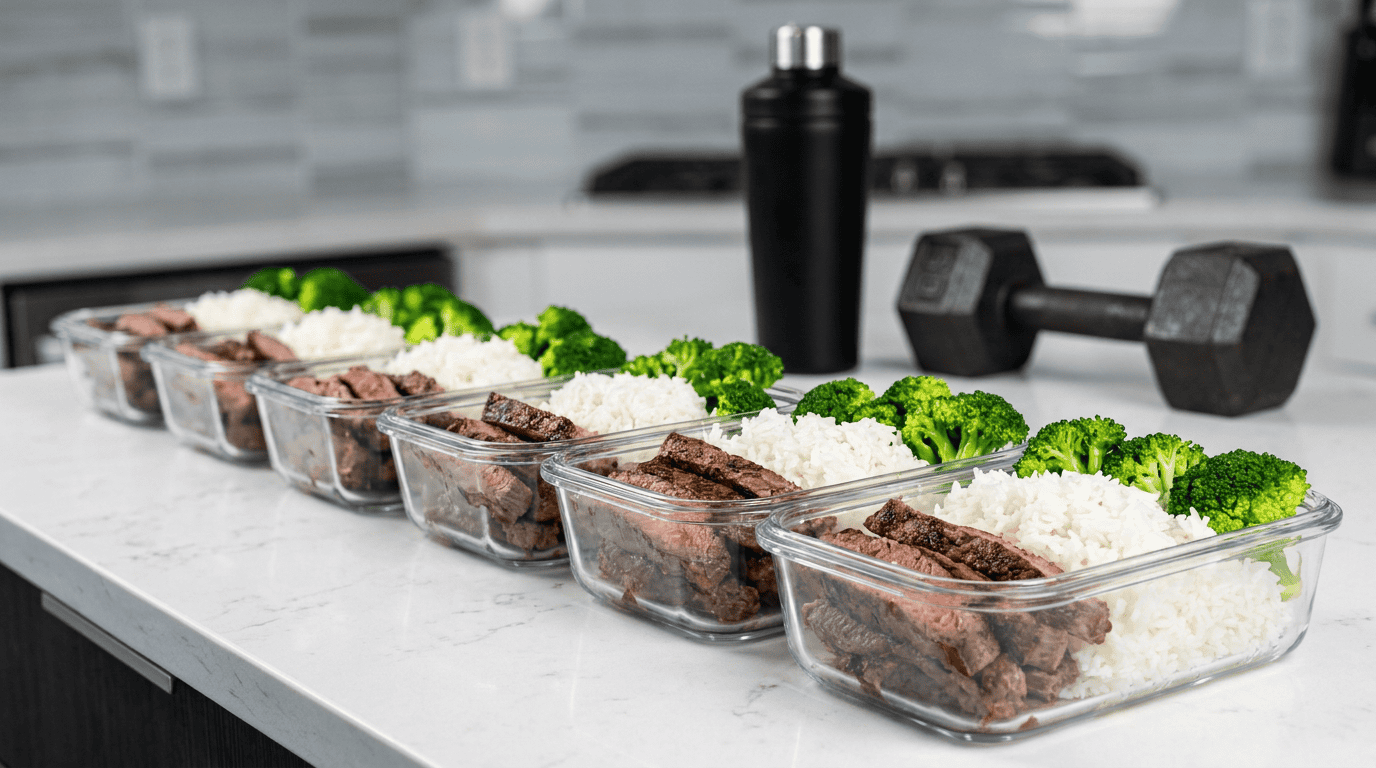
Food is 60% of the muscle-building equation. Guys who ignore this spend years wondering why their gym time isn’t producing gains. The framework is simple; the discipline of executing it is where most people fail.
Start with your maintenance calories — roughly your bodyweight (lbs) × 15 for a moderately active lifter. Add 300-500 calories on top for a bulking target. Track for two weeks and adjust based on the scale: 0.5-1 pound of gain per week is the sweet spot. Slower means you’re not eating enough; faster means you’re piling on fat that will haunt you when you cut.
Protein is the foundation. Target 0.7-1.0g per pound of bodyweight daily, spread across 4-5 meals of 30-45g each. Muscle protein synthesis maxes around 40g per feeding, so backloading everything into two mega-meals wastes potential. Whole eggs, lean beef, chicken breast, Greek yogurt, and whey shakes rotate through most serious bulks.
Carbs fuel your training. Aim for 40-50% of total calories from oats, rice, sweet potato, pasta, and fruit. Fast carbs around your workout (before and after), slow carbs the rest of the day. Cutting carbs during a bulk is the fitness industry’s most persistent bad advice — it kills your training intensity within two weeks.
Fats matter for hormone production (see the next section) and for hitting calorie targets efficiently. Aim for 20-30% of calories from olive oil, avocado, whole eggs, nuts, and fatty fish.
03. Optimize Hormones

Testosterone, growth hormone, cortisol, and insulin signaling collectively determine how efficiently your body converts training and food into new muscle tissue. Get these hormones into a favorable state, and the same training and nutrition inputs produce dramatically better outputs. Get them wrong, and even perfect training and diet produce mediocre results.
Testosterone is the big lever most guys focus on. Natural production drops roughly 1-2% per year after age 30, and lifestyle factors (sleep debt, chronic stress, low body fat, low dietary fat) can accelerate that. The good news: you have real levers to pull. Adequate sleep, adequate calories, adequate cholesterol from dietary fats, and resistance training itself all support testosterone production. Beyond that, specific ingredients have varying degrees of research support.
FEATURED · START HERE 4 Best Over-The-Counter Testosterone Boosters in 2026 →
Ingredients worth understanding:
Supplement stacks worth reviewing:
Sleep 7-9 hours. Manage stress. Eat enough fats. Then evaluate whether a supplement makes sense.
04. Steal A Hollywood Routine

Hollywood physiques get built the same way yours does — with a compound lifting program, a real calorie surplus, and 8-16 months of consistent execution. The difference isn’t secret techniques. It’s that the actor has full-time trainers, chefs, and financial motivation to actually stick with the framework for the whole shoot.
Reverse-engineering these transformations gives you three useful things: a template of what a fully-committed program looks like, real numbers you can benchmark against, and the specific split each actor used for their particular goal.
Frequently Asked Questions
How Long Does It Take To Build Noticeable Muscle?
Strength improvements show up in 2-3 weeks — your lifts start moving before your mirror does. Visible muscle changes take 8-12 weeks of consistent training with adequate nutrition. Dramatic transformations of 10+ pounds of visible muscle require 6-12 months of committed work. Anyone promising faster than that timeline is either selling you something or has assumptions about your starting genetics they can’t back up.
Realistic yearly ceilings: beginners can add 8-15 pounds of lean mass in year one under ideal conditions. Intermediates (year 2-3) typically add 3-6 pounds per year. Advanced lifters (year 4+) fight for 1-3 pounds per year. Guys who quit after 3 months because “nothing was happening” gave up right before the visible progress phase would have kicked in. Consistency across 24 months matters more than intensity across any single week.
Can You Build Muscle Without Supplements?
Yes, absolutely. Supplements are useful convenience tools, not requirements. Every foundational element of muscle building — progressive training, adequate protein, calorie surplus, sleep, hormone health — can be achieved through whole food and lifestyle choices alone. Historical bodybuilders built impressive physiques on whole milk, eggs, and steak long before the supplement industry existed.
That said, two supplements offer genuine value-for-cost: whey protein makes hitting your daily protein target 10x easier, and creatine monohydrate at 5g per day is the single most research-supported hypertrophy supplement in existence. Both are cheap ($15-30 per month combined) and both work. Beyond those two, supplements exist on a scale from “moderately useful for specific situations” to “expensive placebo.” Optimize training, diet, and sleep first.
Are Testosterone Boosters Actually Worth Taking?
The honest answer: it depends heavily on your baseline. Testosterone boosters can meaningfully help men whose natural T levels have declined below optimal ranges — typically men over 35-40, men with high chronic stress, men recovering from low-calorie diets, or men with suboptimal sleep hygiene. In these cases, the right formulation can produce a modest but real bump in energy, libido, and recovery.
For a 25-year-old with normal T levels, adequate sleep, and normal training frequency, most testosterone boosters won’t produce meaningful measurable effects. Your natural production is already near its ceiling. If you decide to test one, look for formulations with clinical-dose ingredients (D-Aspartic acid, zinc, magnesium, ashwagandha, vitamin D3) rather than proprietary blends that hide ingredient amounts. Our 4 best OTC testosterone boosters roundup evaluates the leading options on formulation quality, third-party testing, and real-world value.
Bringing It Together
Building muscle isn’t a mystery, and it isn’t fast. It’s a system: hit each major muscle group twice per week with progressive overload, eat 300-500 calories above maintenance with 0.7-1.0g of protein per pound of bodyweight, support hormone health with sleep and adequate dietary fat, and stay at it for months at a time.
That framework works for the college kid stepping into a gym for the first time. It works for the 45-year-old adding muscle after 15 years off. It works for the actor building a superhero physique. The variables change; the principles don’t.
The trap most guys fall into isn’t lack of information — it’s constant program-hopping. Six weeks of one system, then bailing because gains felt slow, then six weeks of the next system, forever chasing the next thing. Pick a program that fits this framework, run it for 12 weeks minimum, track your lifts, eat your target, sleep well, and evaluate results honestly at the 12-week mark. Then decide whether to continue, adjust, or pivot.
That’s the entire game. Everything on this page is elaboration.
Research-driven content group focused on evidence-based supplement reviews and health information for men. All content is fact-checked against current sports nutrition and endocrinology literature. Read our editorial process.